
 1 year ago
223
1 year ago
223 A British tourist is in intensive care after being attacked by a shark in Trinidad and Tobago.
The incident has prompted the government of southeastern Caribbean nation to shut seven beaches and a marine park.
The attack occurred at Turtle Beach along Great Courland Bay on Tobago with the closure including beaches along the northwestern coast of the island.
The shark appeared to be a bull shark, according to the Tobago House of Assembly, and was 8-10ft long and 2ft wide.
Chief Secretary Farley Augustine said the 64-year-old man was in a "stable" condition but had suffered severe injuries to his arm, thigh and stomach.
A watersports manager at a beach hotel who saw the incident said the man was about waist deep in the water when the shark attacked.
He told local media their backs were turned, and they did not see the shark approaching.
"The other people in the water were physically trying to fight the shark off while it attacked," he added.

Follow Sky News on WhatsApp
Keep up with all the latest news from the UK and around the world by following Sky News
In a statement, the government said shark sightings were reported in the Grafton area and the Buccoo Reef Marine Park.
Officials said the closures will allow the coastguard and Department of Fisheries to investigate the incident and "neutralise the shark threat, if possible".
Please use Chrome browser for a more accessible video player
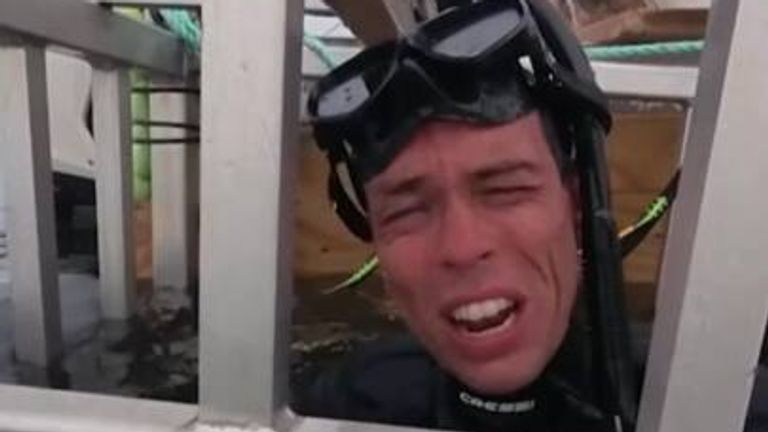
A Foreign Office spokesperson said: "We are supporting the family of an injured British man in Tobago and are in contact with the local authorities."
Last year, there were 69 unprovoked attacks and 22 provoked bites worldwide, along with 14 fatalities, according to the Florida-based International Shark Attack File.
Shark attacks in Tobago a rarity
Many experts consider bull sharks to be among the most dangerous in the world.
Historically, they are one of the three species most likely to attack humans, alongside great whites and tiger sharks, according to the National Geographic.
But their presence is rarely felt in Tobago.
In fact, there have only been two other shark attacks there in the past 20 years, data from Florida Museum's International Shark Attack File shows.
One of those - a non-fatal attack in 2004 - was a bull shark.
They are far more frequent off the eastern and southern US coasts and in the central Caribbean.
Bull sharks get their name from their short, blunt snout, as well as their aggressive disposition and a tendency to head-butt their prey before attacking, the National Geographic says.



















 Bengali (Bangladesh) ·
  English (United States) ·