
The world has a “moral responsibility” to support the fight for survival being faced by small island states, according to a leading UN agency chief.
Ahead of the fourth annual conference of small island developing states (Sids) being held in Antigua and Barbuda this week, Jorge Moreira da Silva, the executive director of the (Unops), called for recognition of the problems faced by what he called “some of the most vulnerable economies in the world” who contributed less than 1% to global carbon emissions.
“Because of their unique circumstances and vulnerabilities, Sids face higher levels of debt distress than other developing countries,” said da Silva. “Over 40% of Sids are now on the edge of, or are already grappling with, unsustainable levels of debt. And with every major disaster, private external debt in Sids tends to rise. Between 2016 and 2020, Sids have paid in debt service 18 times more than what they received as climate finance.
“They are excessively dependent on international trade”, he said, “with limited resources, remoteness from major markets, and susceptibility to natural disasters. They were already in an incredibly difficult situation before being severely hit by the economic consequences of the pandemic. As a result, their GDP contracted on average by 6.9% in 2020, compared with 4.8% in all other developing countries.”
The Sids conference encompasses 37 UN member states, including 16 from the Caribbean, which are disproportionately affected by the climate crisis. Da Silva said Sids had limited access to development resources and were often ineligible for debt-relief mechanisms because of their gross national income per capita, even when they are exposed to so much risk. Practical solutions were required to broaden their options, he said.
“Besides the need for more financing, there are issues around capacities for implementation, whether these are human or technical capacity constraints,” da Silva said.
Many nations require more capacity to identify national needs and focus on long-term planning, da Silva emphasised. “Sids contribute less than 1% of global carbon emissions yet suffer disproportionately from climate change impacts. The people of Sids are at the forefront of a climate crisis they did not create. The international community has a moral responsibility to support their efforts to fight climate change and build a resilient and sustainable future.
“We should care and support not just in the spirit of solidarity and climate justice, but because the fate of Sids are intertwined with that of the entire global community. Lest we forget, Sids are crucial stewards of the ocean, they are home to a large portion of our world’s biodiversity.”
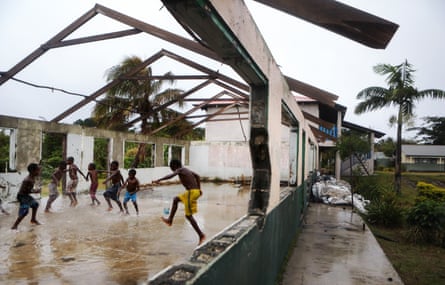
TANNA, VANUATU - DECEMBER 06: Kids play in the rain in a school building heavily damaged by Cyclone Pam, during the first significant local rainfall in months in an extended dry season, on December 06, 2019 in Tanna, Vanuatu. The school is slowly being repaired. The category 5 cyclone heavily damaged many schools on the island. Satellite data show sea level has risen about 6mm per year around Vanuatu since 1993, a rate nearly twice the global average, while temperatures have been increasing since 1950. 25 percent of Vanuatus 276,000 citizens lost their homes in 2015 when Cyclone Pam, a category 5 storm, devastated the South Pacific archipelago of 83 islands while wiping out two-thirds of its GDP. Scientists have forecast that the strength of South Pacific cyclones will increase because of global warming. Vanuatus government is considering suing the worlds major pollution emitters in a radical effort to confront global warming challenges and curb global emissions, to which it is a very small contributor. (Photo by Mario Tama/Getty Images) Photograph: Mario Tama/Getty Images
Da Silva said that for many states the climate crisis was simply about survival.“This conference’s main objective is to call for bold actions to support Sids to build a more sustainable and resilient future. It is expected to culminate with the adoption of a new programme of action for the next decade, to revitalise economies, manage disaster risk and preserve natural habitats.”
He said Unops, the agency for project management and infrastructure, had been working with partners, including strengthening healthcare in Barbados in collaboration with India, supporting a system to store rainwater in the Maldives, working on coastal protection in Kiribati and an early weather warning system in Timor-Leste.
The conference, he added, was a unique opportunity to work towards a future for Sids, “one in which they are prosperous, resilient and sustainable, in harmony with their culture and their biodiversity”.













 Bengali (Bangladesh) ·
  English (United States) ·