
 1 year ago
261
1 year ago
261 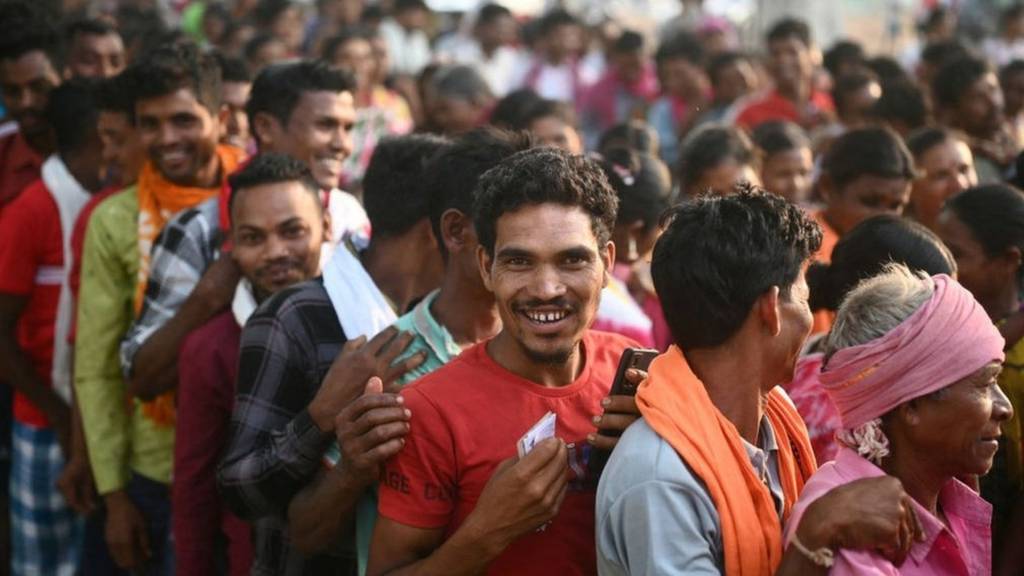
1,289
viewing this page
Related Video and Audio


RTL
Got a TV Licence?
You need one to watch live TV on any channel or device, and BBC programmes on iPlayer. It’s the law.
Live Reporting
Produced by Geeta Pandey & Sharanya Hrishikesh
All times stated are UK
The electoral bonds controversy
Electoral bonds, launched by PM Modi’s government in 2018, were aimed at cleaning up the murky financing of political parties.
But in February, the scheme, which allowed people and companies to make anonymous donations to parties, was banned by the Supreme Court. The judges called the scheme unconstitutional, saying it lacked transparency.
The court also ordered the government-run State Bank of India (SBI) to provide details of who bought these bonds and which party received how much.
The BJP was the biggest beneficiary of the scheme, securing almost half of the bonds worth 120bn rupees donated between 2018 and 2024 - something that isn’t looking good on Mr Modi’s report card.
Media reports have linked many of the donations to companies that were being investigated by government crime agencies, leading to accusations from the opposition that the government was using investigating agencies for “extortion” – a charge several ministers have denied.
Read more here
Strife-hit Manipur votes
Voting is also underway in parts of Manipur, the north-eastern state hit by deadly ethnic violence since the summer of 2023.
Clashes between the majority Meitei group and the Kuki minority have routinely made headlines and thousands have been displaced and are living in relief camps.
The region usually has high voter turnout but many members from the two communities have indicated they may abstain in this election.
At 11am, the state had a 29.1% turnout, according to the Election Commission.

Copyright: Election Commission
What are parties promising?
The BJP manifesto praises the government's track record from the past decade and highlights the benefits of its welfare schemes.
The party bats for its government to be voted back into power in the name of stability and says it will turn India into a developed nation by 2047. It promises to implement a Uniform Civil Code - a single personal law for all citizens irrespective of religion, gender and sexual orientation - and a women’s reservation law passed in parliament last year.
It also promises to implement one of its key talking points - "one nation, one election" or simultaneous federal and state polls - if voted back to power.
The opposition Congress party’s manifesto highlights unemployment and inflation in the country, and promises to deliver justice to oppressed communities.

Copyright: Getty Images
It promises to give a one-year apprenticeship to every diploma holder or graduate younger than 25 years, a legal guarantee of assured prices for certain crops, raising the quota cap for socially-disadvantaged caste-based groups and tribespeople, and full statehood for Jammu and Kashmir.
If it comes to power, the party says, it will investigate a controversial scheme introduced by the BJP government that allowed political donors to remain anonymous.
The Trinamool Congress, which governs West Bengal and is part of an opposition coalition, says the bloc will repeal a controversial citizenship law - which critics call anti-Muslim - if it comes to power.
The Communist Party of India (Marxist), another member of the opposition coalition, has promised to repeal "draconian" anti-terror laws such as the Unlawful Activities Prevention Act and promises to dismantle all nuclear weapons in India.
Going the extra mile to vote
Michael Innes
Reporting from Uttar Pradesh

Copyright: BBC
The atmosphere at the polling station we visited in the town of Kairana in rural Uttar Pradesh was relaxed. In the courtyard of a pale, two-storey building with pink pillars and arches - originally a hostel for pilgrims - voters from all communities were making a modern-day pilgrimage to cast their ballots.
One of the first voters we saw was 93-year-old Rameshwari, who had a broken hip and was being carried by her grandson. She was wearing a lilac-coloured, floral sari and was tightly clutching her identity card, as she was taken to the front of the queue. It was a women-only queue, separated from the men’s queue by a bamboo railing.
She later told us that she hoped her vote in this election would mean she would start getting her pension again.
Reporters' diary: Voting trends
The BBC's Samira Hussain gives a quick update on the first day of polling in India.
Video content
A verdict on the economy?
Nikhil Inamdar
India Business Correspondent
In the 10 years that Mr Modi been in power, India’s economy has gone from being clubbed into a grouping called the “fragile five” to finding a place in the world’s top five. On the face of it, ‘Modinomics’ appears to be working. The country’s GDP is outpacing most other economies.
Its dilapidated infrastructure is getting a shiny fix with the government picking up a $100bn tab every year for road, rail and port construction. And the likes of Apple and Tesla are looking at the country as an alternative destination to China - part of a global diversification strategy adopted by Western MNCs.
But there are problems. Inequality is at a record high. Growth in household consumption is at a two-decade low. The private sector is not investing enough and jobs are hard to come by. The rich have gotten richer, while the vast majority remains poor, living on the margins of sustenance, with 800 million people living on food handouts.
Despite the mixed bag performance, business confidence in India remains high and the stock markets are soaring. As the citizens of the world’s most populous nation cast their vote, there’s no doubt the economy will hold a big sway on people’s minds.

Copyright: Getty Images
Tamil Nadu: Stars come out to vote
It's always fun to spot celebrities coming out to vote, and the election in Tamil Nadu gave plenty of opportunities for that.

Copyright: PTI

Copyright: PTI

Copyright: PTI

Copyright: PTI
Reporters' diary: Voting in rural India
The BBC's Yogita Limaye is at a polling booth in rural Uttar Pradesh where many are queuing up to cast their votes.
Video content
Can a grand temple win votes?

Copyright: Getty Images
In January, Mr Modi inaugurated a big temple to Hindu god Ram in the city of Ayodhya, fulfilling a long-standing promise from his Bharatiya Janata Party.
The temple was built on land where a 16th-Century mosque was demolished by Hindu mobs in 1992, sparking deadly riots in India.
Its opening ceremony was seen as the informal start of Mr Modi’s election campaign, one aimed at consolidating votes from the country’s Hindu majority.
As we mentioned earlier, in a think-tank's pre-poll survey, more than 22% of respondents said the temple topped their list of the action they "liked most" from the current government while nearly half said the temple's construction would help consolidate Hindu identity.
The jobs question
Nikhil Inamdar
India Business Correspondent

Copyright: Getty Images
Earlier this year, photos showing dozens of men standing outside recruitment centres in the northern city of Lucknow were representative of India’s grim jobs crisis. Undeterred by the war in Gaza, they were seeking to go to Israel for menial work in the construction industry.
Unemployment in India is hovering at 7-8% levels, according to private data provider CMIE, and it’s a far worse scenario for the youth and women. Female workforce participation has declined steadily over the past three decades. Barely three out of 10 women do paid work as opposed to eight out of 10 men.
Joblessness among educated youth, meanwhile, has doubled from 35.2% to 65.7% between 2000 and 2022, according to latest figures from the International Labour Organization.
Job creation is a problem that neither Mr Modi or his predecessors have been unable to solve, despite fast growth. The World Bank’s regional economist Franziska Ohnsorge warned in a recent Financial Times interview that India risked "squandering" its demographic dividend, the economic growth potential from a big working age population.
All in the family
Three generations of a family - Prabha Sharma (second from right), her daughter and two granddaughters - were spotted posing cheerfully for reporters after voting at a polling station in Dehradun in the northern state of Uttarakhand.

Copyright: ANI
Watch: Welcoming voters with flowers and bananas
Video content
The welfare juggernaut

Soutik Biswas
India Correspondent
Since taking office in 2014, Mr Modi has allocated funds for more than 300 federal welfare programmes, with a focus on women and farmers. These include essentials like cooking gas, grain, housing, toilets and financial assistance. Many benefits, including pensions, subsidies, loans and scholarships, are disbursed via cash transfers to bank accounts linked to biometric IDs held by over a billion Indians. Massive posters of Mr Modi promoting these initiatives dot the landscape.
Surveys show voters identify welfare programmes with the ruling parties, and that the number of households who are using clean cooking fuel, toilets and women's access to bank accounts have increased since Mr Modi came to power in 2014. Yet, evidence of welfare translating to votes is more mixed. Victories in Indian elections aren't determined by a single factor - caste, demography and religious identity are other key predictors of support for a party.
Watch: Three things you need to know about the election
Video content
When will we know the results?
It will take exactly 47 days to find out who has won the election. We know that’s an excruciatingly long wait but the staggeringly large scale of the polls makes that necessary.
What has kick-started today is the world’s biggest electoral exercise, and each of the country’s roughly 969 million registered voters will get a chance to cast their ballot.
Voting will stretch across April and May and end on 1 June. The results will be declared on 4 June.

Copyright: BBC
Greater Andamanese: Ancient tribe comes out to vote
Members of an ancient tribe came out to vote in the Strait Island near Port Blair, the capital of the Indian Ocean archipelago of Andaman and Nicobar.
The Greater Andamanese are believed to have a population of just over 50, and mostly live on one of the 37 islands in the coral reef-fringed archipelago.

Copyright: Election Commission

Copyright: Election Commission

Copyright: Election Commission
What these women want
Yogita Limaye
Reporting from Uttar Pradesh

Copyright: BBC
One of the constituencies voting today is Muzaffarnagar. It's located in the northern state of Uttar Pradesh, which is politically the most important as it sends the maximum number of MPs to parliament.
Right from early in the morning when the polls opened, we’ve seen people filtering in. This commitment to the electoral process is ingrained in Indian culture, especially in rural areas.

Copyright: BBC
Lines are building up now. We met Ambraesh who says that women’s safety is the most important issue for her.
Sahajkali, a 63-year-old labourer, said uppermost in her mind was rising prices as she cast her vote.
Reporters' diary: On the ground in the city of love
Soutik Biswas
India Correspondent
In bustling Agra, home to the iconic Taj Mahal and some two million residents tucked away in cramped homes along narrow, labyrinthine lanes, tourists brave the sweltering heat to marvel at the monument to love.
Agra's political landscape mirrors its eclectic past, with Congress reigning supreme until the late 1970s, followed by the BJP's ascendancy and sporadic victories by figures like Bollywood actor Raj Babbar for the Samajwadi Party in the 1990s.
The city votes in May.

Copyright: BBC
Since 2014, the BJP has held it. I met Siraj Qureshi, a seasoned journalist and interfaith organiser, who lamented the erosion of bonds between Agra's Hindu majority and Muslim minority. "Politics has tainted relationships," he reflected sombrely. He says he perseveres in fostering harmony through events celebrating both Hindu and Muslim festivals such as Holi and Eid.
While Agra has witnessed its share of religious conflict in the past, communalism has now become deeply intertwined with politics, a development Mr Qureshi finds particularly troubling, saying “I pray to God that the good old days return”.
So, he adds, he remains steadfast in his commitment to bridging divides and preserving the city's diverse cultural fabric. Dreams die hard in the city which boasts the world’s most famous monument to love.
The opponent - Rahul Gandhi

Copyright: Getty Images
On the other side is Rahul Gandhi, the Congress party leader who is often called the face of India’s opposition.
Born into India’s most famous political dynasty - his great-grandfather, grandmother and father were prime ministers - Mr Gandhi faces the uphill task of reviving his party’s fortunes after it suffered massive defeats in the last two general elections against Mr Modi’s BJP.
Over the years, he has been accused - sometimes by his own party members - of being a reluctant politician who isn't serious enough to put up a tough fight to the popular prime minister.
But since 2022, he has travelled the length and breadth of the country to counter that opinion and position himself as a spirited leader.
Read more: What you need to know about Rahul Gandhi
The man in focus - Narendra Modi

Copyright: Getty Images
What you need to know about Narendra ModiAll elections are important but for Prime Minister Narendra Modi, this one is particularly crucial. He and his Bharatiya Janata Party (BJP) are aiming for a third straight term in power.
If he becomes PM again, he will equal the record of Jawaharlal Nehru, India’s first prime minister.
The 73-year-old is the most prominent leader in the country currently and his personal appeal among voters and sound political instincts are big driving factors for his party.
He is a divisive figure - his supporters say he is a strong leader who has delivered good governance and foreign policy triumphs. But critics accuse his government of targeting opposition leaders, shrinking space for dissent and marginalising the minority Muslim community - the BJP denies this.
Read more: What you need to know about Narendra Modi











 Bengali (Bangladesh) ·
  English (United States) ·